
One day your fish look fine. The next, they may be covered in tiny, evenly sized white dots that resemble grains of salt. That pattern can occur with ich, also called white spot disease, but appearance alone does not confirm the diagnosis; use the warning and comparison guidance below before treating.
This guide covers how to tell ich from other white spots, how to run a full treatment course safely, the label cautions for invertebrates and sensitive fish, and the five ich treatments fishkeepers use most.
Short version: Check the full pattern and tank conditions, choose one appropriate treatment only when ich is the likely diagnosis, and follow that product’s label exactly for the full course. Check every label for species, shrimp, snail, plant and scaleless-fish cautions before dosing.
Quick picks for treating ich
Most popular ich treatment: Aquarium Solutions Ich-X, White Spot Disease Treatment, 16 oz
Check price on Amazon
Big-brand liquid: API Liquid Super Ick Cure, 16 oz
Check price on Amazon
Small tanks: API Liquid Super Ick Cure, 1.7 oz
Check price on Amazon
Lost fish suddenly? Our guide to why fish suddenly die covers water problems to rule out.
Ich or Something Else?
| What you see | Could be | Next step |
|---|---|---|
| Small, even white dots like salt or sugar, fish flashing or rubbing | Ich (white spot) | Treat per the label |
| Fine gold or rusty dust, often on the body | Velvet | Ich-X lists velvet on its label; get advice |
| Fluffy, cotton-like white tufts | Fungus | Different treatment; ask a fish store |
| White dots only on a male’s gills or head in breeding season | Breeding tubercles (some fish) | Not a disease; observe |
How to Run a Full Treatment Course
- Test the water. Check ammonia, nitrite and nitrate first. Our aquarium water test kits guide covers the options.
- Remove carbon if the label says so. API’s directions say to remove activated carbon and keep aerating, and ParaGuard says to remove chemical filtration. Carbon can pull medication out of the water.
- Measure your tank. Dose for the actual water volume, not the tank’s label size, and follow the label amount exactly.
- Finish the course. Ich hides in the water and gravel between visible stages, so keep going for the full course on the label even after the spots are gone.
- Change water and restore carbon after. Follow the label’s end-of-treatment steps.
Invertebrates and Scaleless Fish: What the Labels Say
| Product | Invertebrates | Scaleless or sensitive fish |
|---|---|---|
| API Super Ick Cure | Label: corals and invertebrates may be sensitive; not recommended in tanks with invertebrates | Not stated on the listing; check the bottle |
| Seachem ParaGuard | Label: not recommended with invertebrates; remove them before treating | Not stated on the listing; check the bottle |
| Tetra Ick Guard | Not stated on the listing; check the box | Label: use half strength for scaleless or sensitive fish |
| Ich-X | Not stated on the listing; check the bottle | Not stated on the listing; check the bottle |
Loaches, many catfish and other scaleless fish are often described as sensitive to ich medications, which is why Tetra gives a half-strength dose. If you keep shrimp, snails or scaleless fish, read the full label before you buy, or ask the maker.
The Picks, Up Close
Aquarium Solutions Liquid Ich-X Formula, White Spot Disease Treatment, 16 oz

The Ich-X label lists ich, velvet, Saprolegnia and Cryptocaryon, and identifies formaldehyde, methanol and malachite green chloride among its ingredients. The 16 oz bottle is intended for repeated dosing across a full treatment course. Measure the actual water volume, follow the package directions for dosing and filtration, and check the current label for every species and tankmate before use.
Best for: Community freshwater tanks, and bigger tanks where a large bottle makes sense.
API Liquid Super Ick Cure Freshwater and Saltwater Fish Medication, 16 oz

API Super Ick Cure 16 oz — Check price on Amazon
API’s liquid is sold for ich in freshwater and saltwater fish. API says it typically kills the parasite within 24 hours of the first dose and adds a synthetic slime coat to help protect fish against secondary infection. The label says to remove carbon, follow the repeat-dose schedule and finish with a water change, and warns that it can discolor water and stain sealant and ornaments. It is not recommended for reef tanks or tanks with invertebrates.
Best for: Fish-only freshwater and saltwater tanks.
API Liquid Super Ick Cure Freshwater and Saltwater Fish Medication, 1.7 oz
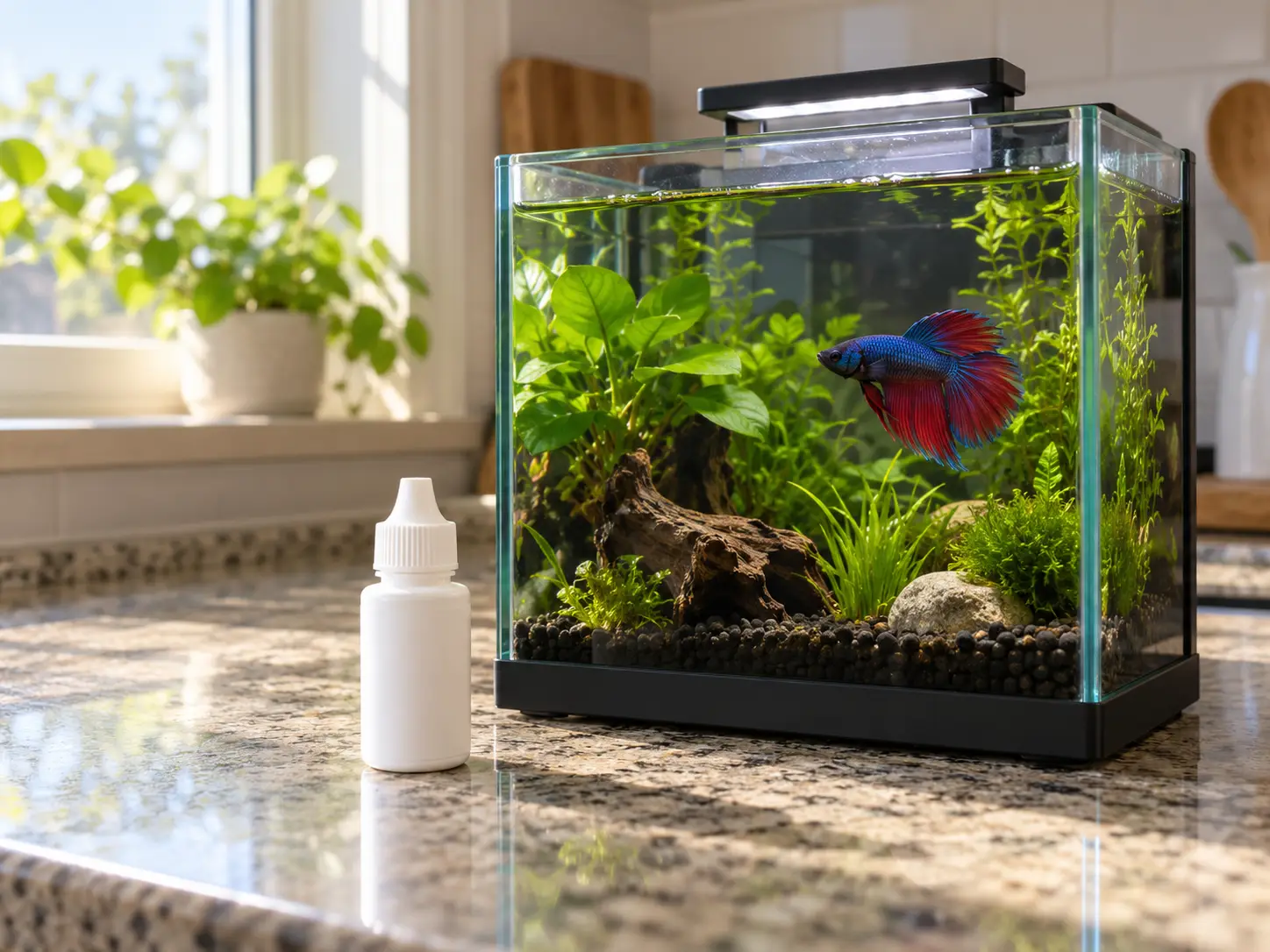
API Super Ick Cure 1.7 oz — Check price on Amazon
The same API formula in a small bottle. For nano tanks, bettas and quarantine tubs, a small bottle means you aren’t storing medication you won’t use. Same label cautions as the large size.
Best for: Small and quarantine tanks.
Seachem ParaGuard, 500 mL

Seachem ParaGuard — Check price on Amazon
ParaGuard is an aldehyde-based parasite treatment with malachite green and fish-protective polymers. Seachem says it contains no formaldehyde or methanol, won’t alter pH and is filter safe, and that it is particularly useful in hospital and quarantine tanks for new fish. The label says to remove all invertebrates and chemical filtration before use, and to dose daily as long as fish show no stress.
Best for: Quarantine tanks for new fish, and keepers who prefer a formaldehyde-free option.
Tetra Ick Guard Conditioning Remedy for Fish, 8 Count

Tetra Ick Guard — Check price on Amazon
Tetra’s fizz tablets are pre-measured, which takes the guesswork out of dosing: one tablet per 10 gallons, up to 80 gallons per box. Tetra says there is no need to raise the water temperature, and the label says to use half strength for scaleless or sensitive fish. For larger tanks or soft, acidic water, Tetra says to dissolve the tablets first.
Best for: Beginners who want pre-measured doses, and tanks with scaleless fish (at half strength per the label).
Prevent the Next Outbreak
- Quarantine new fish. Keep new arrivals in a separate observation tank before adding them to the display aquarium. This gives you time to watch for spots, breathing changes, appetite loss or other signs before the fish share water and equipment with the established tank.
- Avoid sudden temperature swings. Tetra notes ich often follows sudden temperature changes or stress.
- Don’t overstock. Crowded tanks stress fish. See our aquarium size and stocking guide.
- Watch new fish closely. A new fish that won’t eat may be stressed or sick. Our guide to why new fish won’t eat covers what to check.
FAQ
How long does ich treatment take?
It depends on the product and water temperature. Follow the label’s full schedule, and keep going until the course is complete even if the spots fade sooner.
Should I raise the temperature?
Labels differ. API says treatment may be hastened by raising the temperature, while Tetra says its tablets don’t need it. Follow your product’s label, and only raise temperature if all your fish tolerate it.
Is ich medication safe for shrimp and snails?
API and Seachem both warn against using their products with invertebrates. Check every label, and move invertebrates out or treat fish in a separate tank if unsure.
Can I use two ich treatments together?
Don’t combine medications unless a label says it is safe. Pick one and follow it through.
Final Take
Ich is common and usually treatable when caught early. Ich-X is the most popular choice, API Super Ick Cure comes in large and small bottles for fish-only tanks, Seachem ParaGuard suits quarantine tanks, and Tetra Ick Guard’s tablets make dosing simple, with a half-strength option for sensitive fish. Read the label for invertebrate and scaleless-fish cautions, finish the full course, and quarantine new fish.
Seasonal pet tips and gear guides
Get seasonal pet-care tips and buying guides with fit, care, and maintenance details. Unsubscribe anytime.