
Best Canister Filters for Aquatic Turtles
Turtle tanks need regular waste removal and water care. Cloudiness, odor or reduced flow is a reason to review feeding, debris and maintenance before assuming that a larger filter is the answer.
A canister can provide mechanical and biological media outside the tank. Compare the named models below by their listed aquarium ratings, media arrangement and service requirements. A filter does not replace water changes.
Quick Comparison
The comparison uses the linked listings’ aquarium ratings. These are not guaranteed turtle-tank sizes. Match a filter to actual water volume, waste load, flow and maintenance access, and verify the exact model before buying.
| Model | Listed aquarium rating | Design feature | Checks before buying | Maintenance limit |
|---|---|---|---|---|
| Fluval 207 | Up to 45 US gal | External canister; lift-out media baskets | Check actual water volume, cabinet space and flow | Regular media service and water changes remain necessary |
| Fluval FX4 | Up to 250 US gal | FX-series external canister | Check footprint, hose routing and service access | Aquarium capacity is not a universal turtle-fit guarantee |
| Penn-Plax Cascade 1200 | Up to 150 US gal | Four stackable media baskets | Check hose placement and approximately 11.5 × 11 × 20.5-inch space | Tank shape alone does not establish better circulation |
| Fluval 407 | Up to 100 US gal | 07-series canister; lift-out media baskets | Compare the actual habitat and available service space | The 407 is not the larger FX-series drum filter |
| Fluval FX6 | Up to 400 US gal | FX-series external canister | Check cabinet clearance and ability to service the unit | More rated capacity does not eliminate maintenance |
How to choose a canister filter for a turtle tank
Consider actual water volume, waste load, media space and cleaning access together. Aquarium capacity ratings are a starting point for comparison rather than a universal turtle-fit rule.
1. Prioritize media space
Bigger media baskets or trays give you more room for sponges, pads, ceramic rings, and other biological media. That matters because turtle tanks need both solid waste trapping and stable biological filtration.
2. Think about cleaning access
A powerful filter is only useful if you can realistically maintain it. Choose a style you can lift, open, rinse, and restart without turning every cleaning into a project.
3. Check habitat fit before buying
Check the model’s installation and flow instructions for the current habitat and planned enclosure. More rated capacity alone does not establish the best choice.
What size filter do aquatic turtles need?
Record the actual water volume and compare it with the model’s aquarium rating, installation limits and maintenance needs. There is no single rating that guarantees suitability for every turtle setup.
Canister filter vs. hang-on-back filter for turtles
Compare the actual filters’ media space, installation, flow and cleaning access. The filter type alone does not establish performance in a particular turtle habitat.
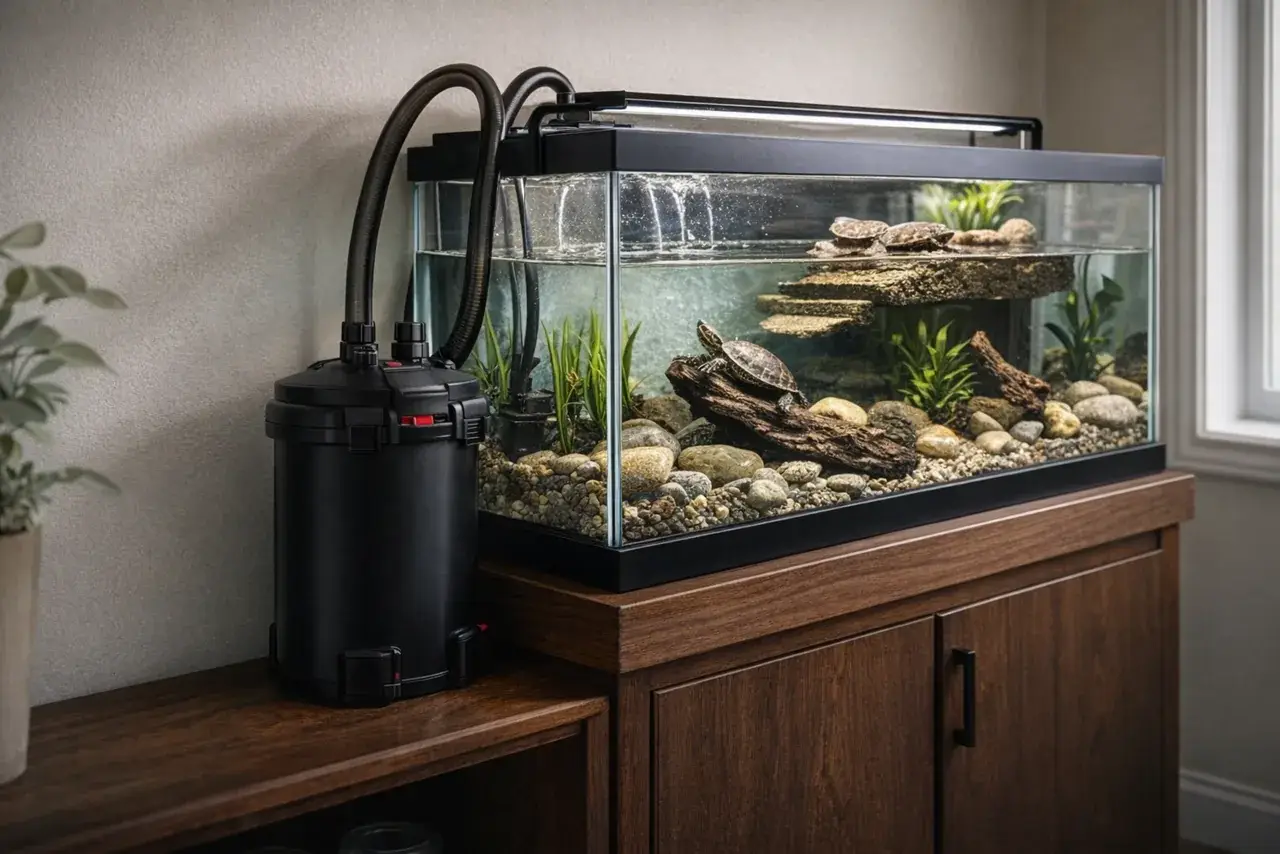
Illustrative habitat scene; this does not show the exact Fluval 207 model. Check the retailer’s product photos.
Fluval 207 Canister Filter
07-series external canister with lift-out media baskets. The linked listing rates it for aquariums up to 45 US gallons. That aquarium rating does not establish suitability for every turtle enclosure.
- 07-series external canister with lift-out media baskets
- Aquarium rating: Up to 45 US gallons
- External placement; check hose and service access
- Check the aquarium rating against actual water volume, waste load and the flow required for the habitat.
- Check actual water volume and waste load
- Plan regular media service and water changes
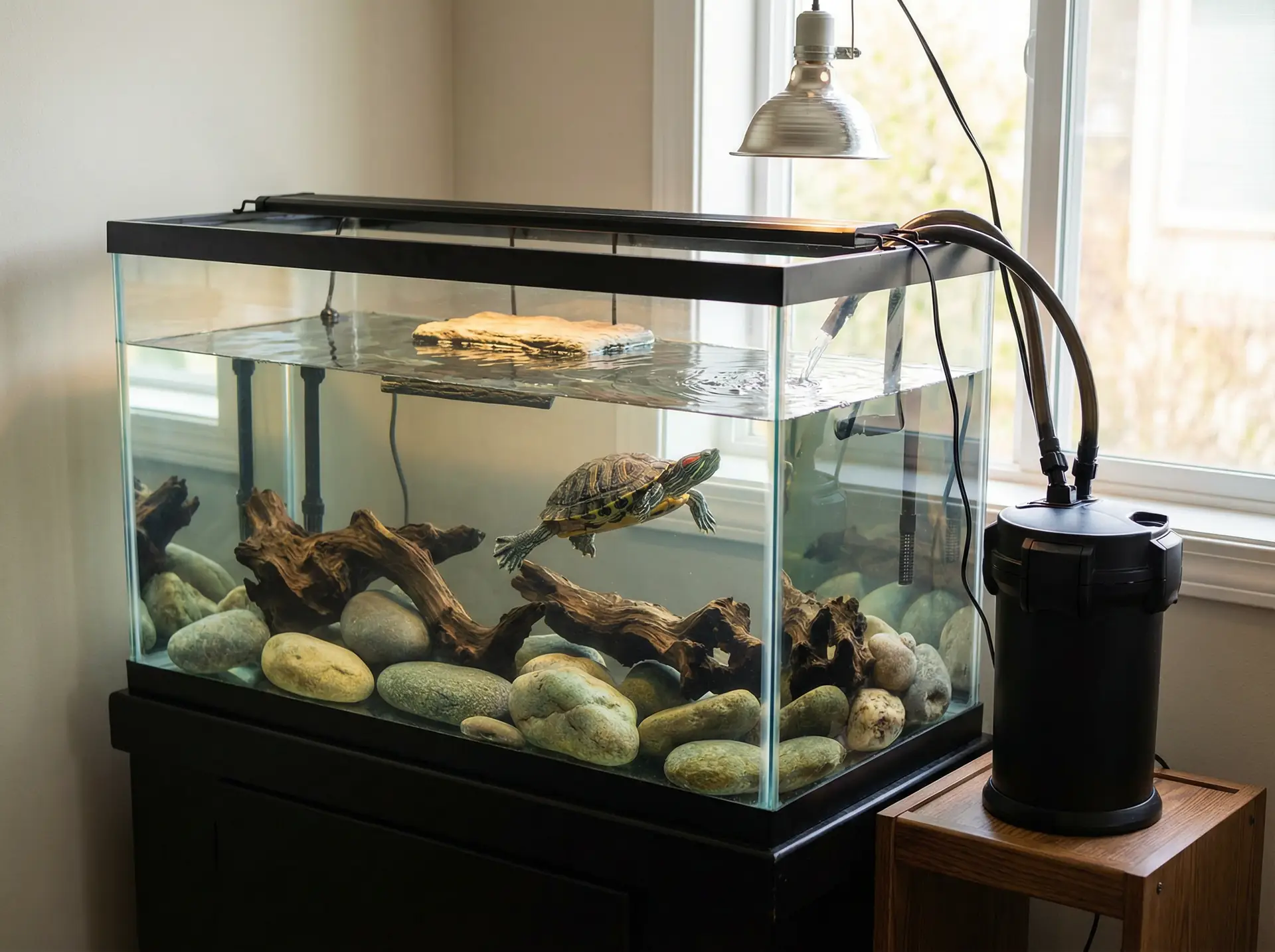
Illustrative habitat scene; this does not show the exact Fluval FX4 model. Check the retailer’s product photos.
Fluval FX4 Canister Filter
FX-series external canister. The linked listing rates it for aquariums up to 250 US gallons. That aquarium rating does not establish suitability for every turtle enclosure.
- FX-series external canister
- Aquarium rating: Up to 250 US gallons
- External placement; check hose and service access
- Confirm cabinet space, hose routing and access for regular service. This is not the same product as the smaller 407.
- Check actual water volume and waste load
- Plan regular media service and water changes
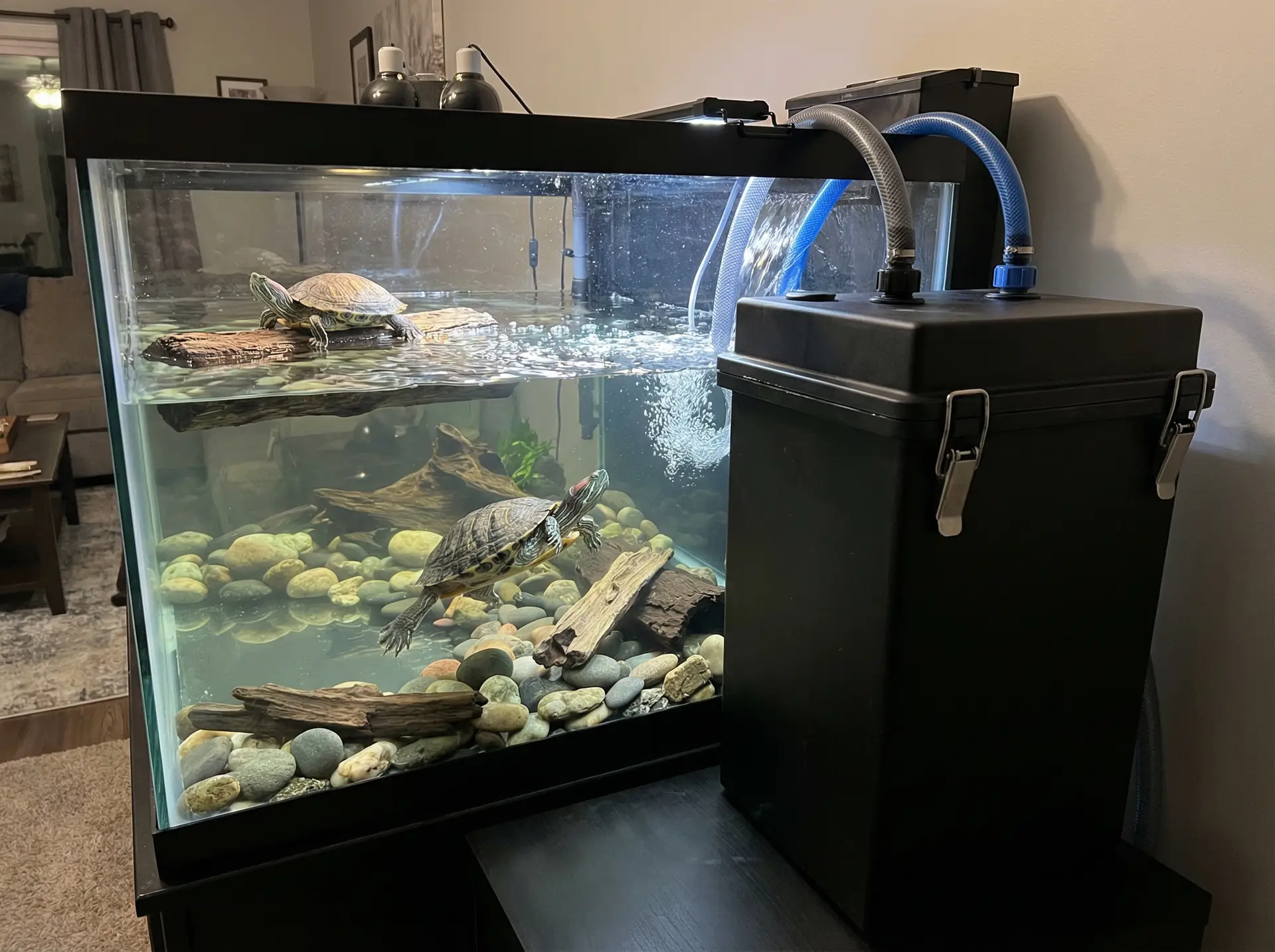
Illustrative habitat scene; this does not show the exact Cascade 1200 model. Check the retailer’s product photos.
Penn-Plax Cascade 1200 Canister Filter
Four stackable media baskets; listed 315 GPH flow. The linked listing rates it for aquariums up to 150 US gallons. That aquarium rating does not establish suitability for every turtle enclosure.
- Four stackable media baskets; listed 315 GPH flow
- Aquarium rating: Up to 150 US gallons
- External placement; check hose and service access
- Allow approximately 11.5 × 11 × 20.5 inches for the unit. Intake and outlet placement still determine circulation; a long tank alone does not make it the best choice.
- Check actual water volume and waste load
- Plan regular media service and water changes
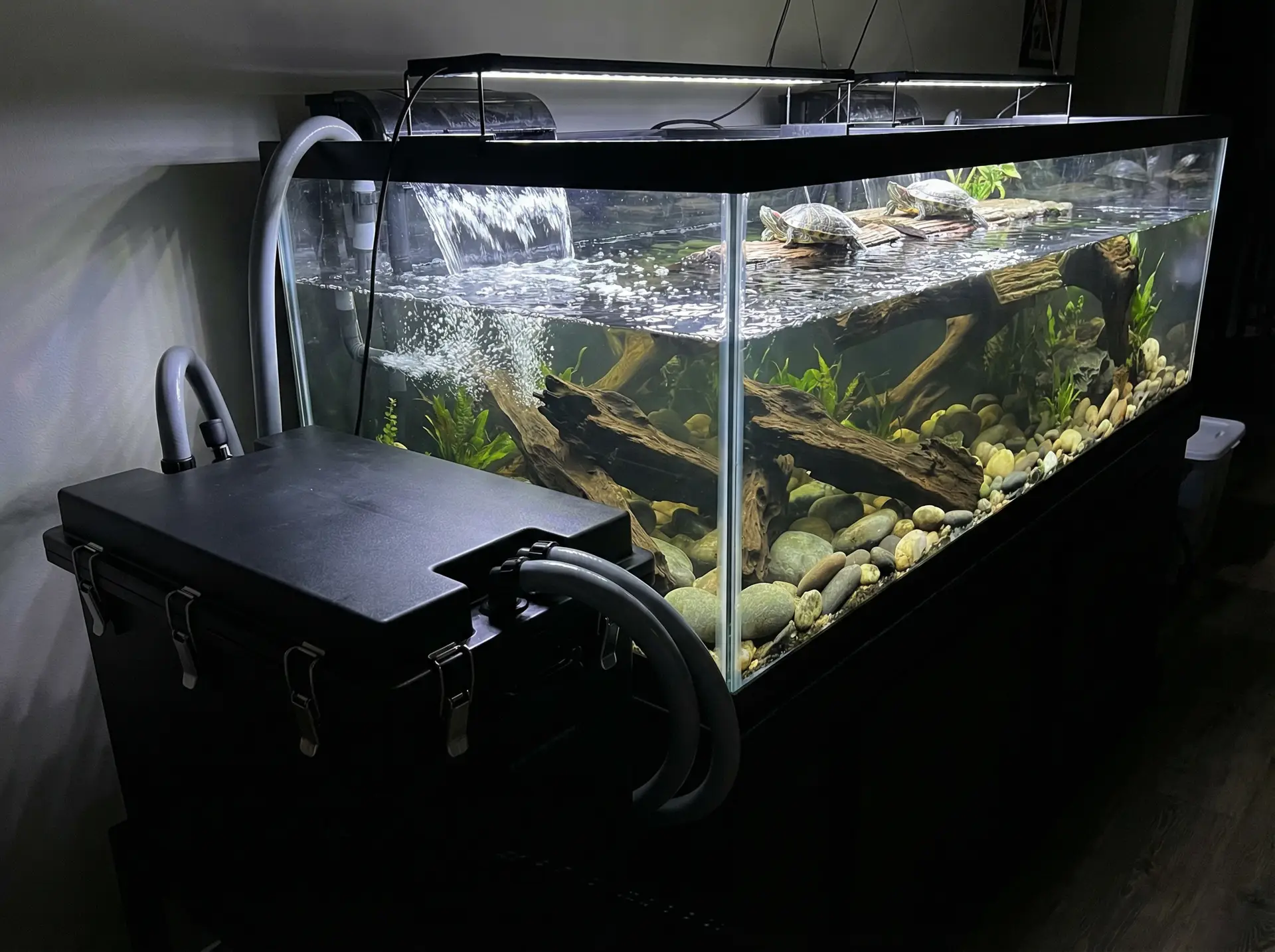
Illustrative habitat scene; this does not show the exact Fluval 407 model. Check the retailer’s product photos.
Fluval 407 Canister Filter
07-series external canister with lift-out media baskets. The linked listing rates it for aquariums up to 100 US gallons. That aquarium rating does not establish suitability for every turtle enclosure.
- 07-series external canister with lift-out media baskets
- Aquarium rating: Up to 100 US gallons
- External placement; check hose and service access
- The 407 is an 07-series canister. Compare its listed rating, installation and service access with the habitat requirements.
- Check actual water volume and waste load
- Plan regular media service and water changes
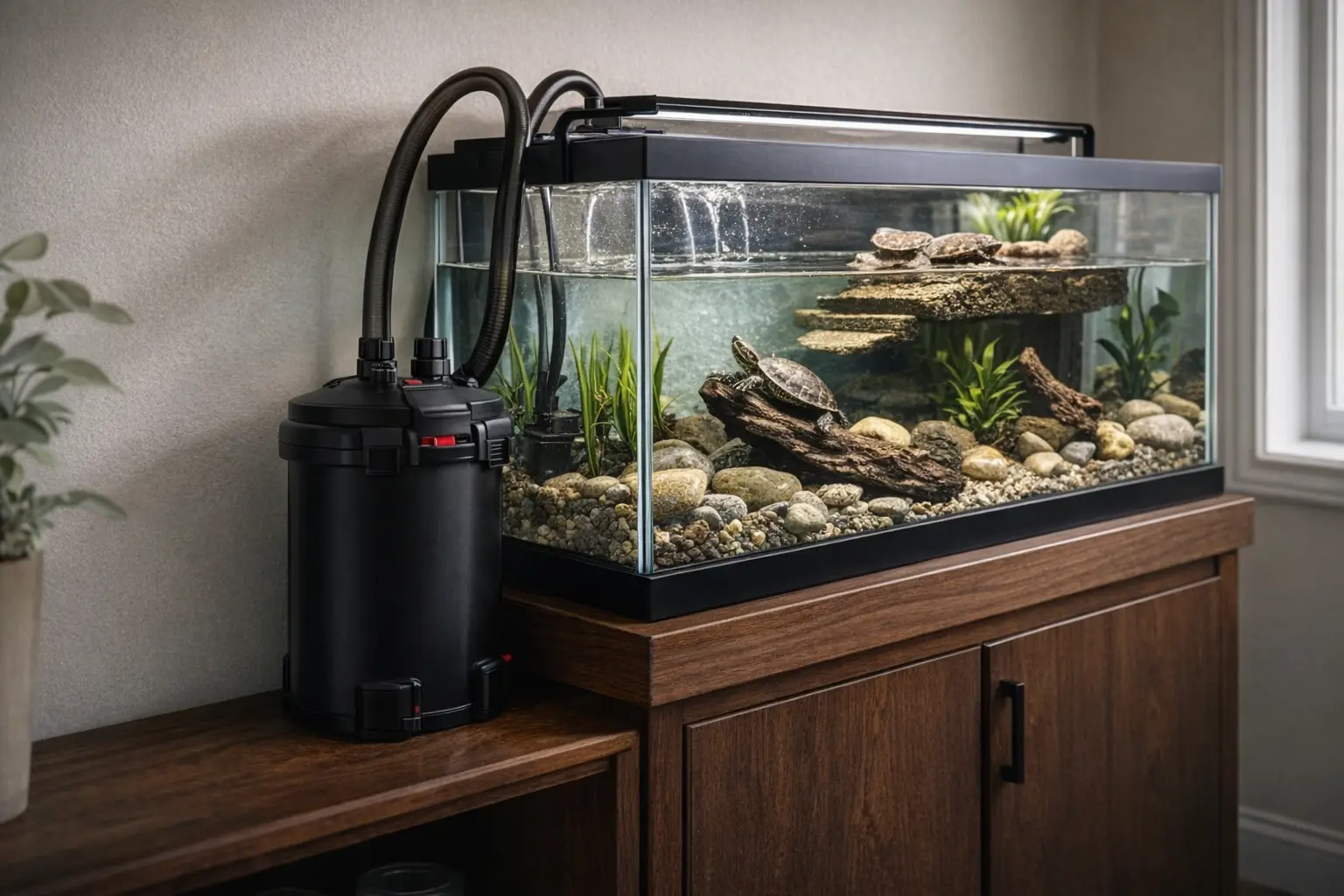
Illustrative habitat scene; this does not show the exact Fluval FX6 model. Check the retailer’s product photos.
Fluval FX6 Canister Filter
FX-series external canister. The linked listing rates it for aquariums up to 400 US gallons. That aquarium rating does not establish suitability for every turtle enclosure.
- FX-series external canister
- Aquarium rating: Up to 400 US gallons
- External placement; check hose and service access
- Confirm clearance and ability to service the unit. More capacity does not remove the need for water changes or mechanical-media cleaning.
- Check actual water volume and waste load
- Plan regular media service and water changes
What actually matters most on a turtle canister filter?
For turtle tanks, the biggest things are mechanical waste handling, media capacity, and real-world maintenance. A filter can look strong on paper, but if it clogs fast or is miserable to service, it will not stay effective.
Choose using the habitat requirements and the model’s instructions. If water conditions change, review maintenance and measured conditions as well as equipment capacity.
Important maintenance note
A strong canister filter helps with water clarity and waste control, but it does not replace regular care. Turtle tanks still need water changes, rinsed mechanical media, and routine filter service. The more waste your turtle produces, the more important that schedule becomes.
A simple pre-filter sponge on the intake can also help catch larger debris before it reaches the canister. That can make cleanings easier and help prevent the mechanical stages from clogging too quickly.
Canister Filter FAQ for Aquatic Turtles
Are canister filters better than hang-on-back filters for turtle tanks?
Compare the specific models’ media space, flow, installation and service access. A canister can suit a habitat, but its category alone does not prove better performance.
Should I oversize the filter for a turtle tank?
Use actual water volume, waste load and the model’s instructions together. An aquarium rating is not a universal turtle-fit guarantee; buying the largest unit is not a substitute for checking installation and maintenance needs.
How often should a turtle canister filter be cleaned?
It depends on turtle size, feeding habits, tank size, and how much solid waste collects in the filter. Many turtle keepers need to rinse mechanical media regularly and do deeper filter maintenance as flow slows down or debris builds up.
Do canister filters remove the need for water changes?
No. A canister filter helps remove debris and support biological filtration, but it does not eliminate the need for water changes. Turtle tanks still need fresh water and routine maintenance to stay healthy.
What is the biggest mistake people make with turtle filtration?
Cloudiness, odor or frequent clogging can have several maintenance or habitat causes. Review debris, feeding, filter service and measured water conditions before deciding whether equipment capacity needs to change.
More Aquatic Turtle Guides
Building a cleaner turtle setup usually takes more than one piece of equipment. These guides can help you finish the rest of the habitat.
Compare the Five Canister Models on Amazon
Check the exact model, current price and installation instructions:
Check price on Amazon
Check price on Amazon
Check price on Amazon
Check price on Amazon
Check price on Amazon