
Why Is My Aquarium Water Cloudy? Causes and Checks
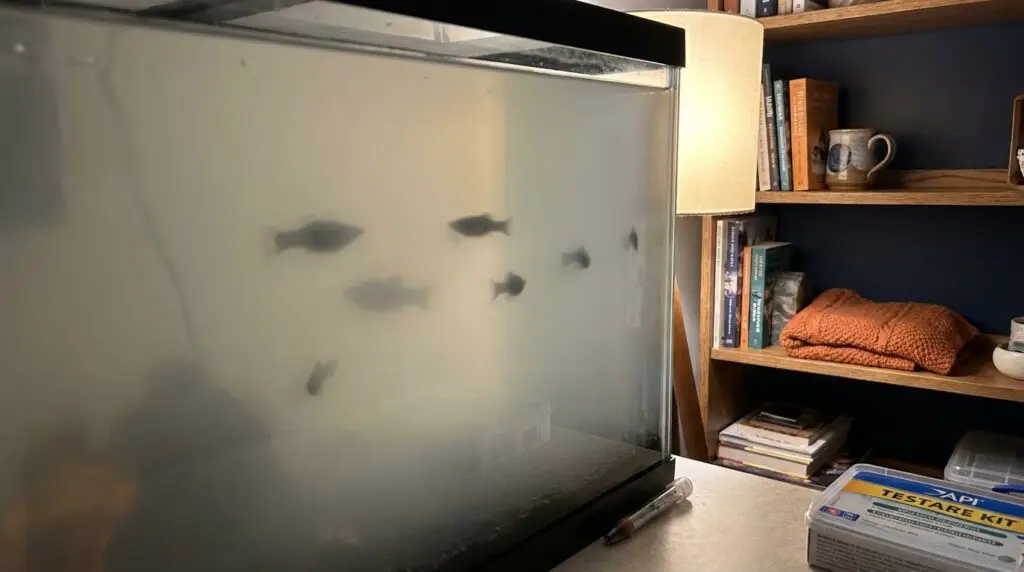
Cloudy aquarium water needs a water-quality check before you choose a remedy. Work through the five possibilities below alongside test results, equipment checks, and the condition of your fish.

Test the water and observe the fish. Appearance and test results are clues, not a complete diagnosis.
First Water-Quality Checks
Note the color and any recent changes to the tank, then check water quality:
- White or grey, milky haze: consider suspended particles and changes in the tank, alongside water tests.
- Green tint: investigate algae and lighting; color alone does not establish the full cause.
- Brown or yellow-brown: review wood, decor, debris, and filter maintenance.
Five Possibilities to Check
New Tank and Biological Filter Checks
In a new tank, check whether the biological filter is established and test ammonia and nitrite. White cloudiness does not by itself confirm that ammonia or a particular bacterial population caused it.
The next step: Keep filtration operating, preserve biological media, and respond to water tests and fish condition. Do not wait for the water to look clear before addressing abnormal results.
Overfeeding or Excess Waste
Review feeding amounts and leftover food, including recent changes. Waste can accumulate even in an established aquarium; do not assign the cause from cloudiness alone.
The next step: Adjust food to the species and remove leftovers. Choose water changes using test results and suitable replacement water. An automatic feeder still needs portion adjustment and checked trial runs.
Unrinsed Substrate or Decor Dust
Check whether substrate or decor was recently added or disturbed, and follow its preparation instructions. Suspended dust is one possibility, but it does not rule out a water-quality problem.
The next step: Check filtration and water results rather than waiting for a fixed clearance deadline. Seek fish-health advice if fish show abnormal signs.
An Undersized or Overdue Filter
Check filter operation, flow, media condition, and the needs of the actual tank and stocking. Cloudiness alone does not prove that a larger filter is needed.
The next step: Follow the filter maker's maintenance instructions and protect established biological media. Rinsing suitable media in removed aquarium water avoids exposing it to untreated chlorinated water. Our HOB filter picks explain features to compare.
Green Water (Free-Floating Algae)
Green water can prompt a closer review of algae, light exposure, and nutrient inputs. Check the fish and water results as well as the appearance.
The next step: Review the lighting schedule against the needs of the fish and plants, and check direct sunlight and feeding. See our algae troubleshooting guide for related checks.
When Cloudy Water Means Something More Urgent
Gasping, abnormal breathing, lethargy, or fish lying unusually at the bottom warrant prompt water testing and fish-health advice. Do not rely on smell or clarity to judge ammonia. See our fish gasping at the surface guide for related checks.
Test the Water and Review the Results
Test ammonia, nitrite, pH, and temperature before choosing a fix. Water tests help narrow causes but may not identify every source of cloudiness.
Pawfly 5 in 1 Aquarium Water Master Test Kit
Before buying, check the exact kit's listed tests, freshwater or marine suitability, expiry, and instructions. Compare those with the readings you need in our water test kit guide.
Check Price on AmazonFAQ
How long does cloudy water take to clear?
Clearance time depends on the cause and tank conditions. Follow test results and fish condition rather than a promised number of days.
Should I do a big water change to fix cloudy water?
Use test results, the fish's condition, and suitable replacement water to choose water changes. Do not withhold needed water changes because the tank is cycling.
Is cloudy water dangerous for my fish?
Appearance alone cannot establish safety. Test water quality and seek fish-health advice for abnormal breathing, activity, or other signs.
Will a UV sterilizer fix cloudy water?
Choose UV equipment for an identified task and follow its instructions. It does not replace water testing, appropriate filtration, or a review of husbandry.