
It often starts small: your dog takes a second longer to get up from the rug, pauses before jumping into the car, or walks stiffly for the first few minutes after a long nap. Record when the change appears, what activity preceded it and whether it is getting worse; those details can help your veterinarian assess the cause.
Joint supplements are one of the most common things owners add for stiff and senior dogs. This guide covers the four we would look at first, what the main ingredients are, how to pick the right one for your dog’s size, and the home changes that matter just as much as anything in a bottle.
Short version: Get new stiffness or limping checked by your vet first. Then pick one supplement made for dogs, dose it by your dog’s weight exactly as the label says, give it every day for several weeks, and keep simple notes so you can tell if it is worth continuing.
Quick picks for stiff and senior dogs
Best place to start: Nutramax Cosequin Joint Supplement for Dogs, Chewable Tablets, 132ct
Check price on Amazon
Best value soft chew: VetIQ Glucosamine Hip & Joint Chews for Dogs, MSM & Krill, 180 Count
Check price on Amazon
Best step-up for dogs under 60 lbs: Nutramax Dasuquin MSM Joint Supplement, Small/Medium Dogs (under 60 lbs), Soft Chews, 84ct
Check price on Amazon
Have a big dog? The large-breed pick is in the second box below. For the furniture side of the problem, see our guide to a senior dog that can’t jump on the couch anymore.
What Is Actually in a Dog Joint Supplement?
Most joint chews are built around the same short list of ingredients. Knowing the names makes the labels much easier to compare:
- Glucosamine and chondroitin. The classic pair. Cosequin, Dasuquin and Wuffes all list both, and VetIQ lists glucosamine.
- MSM (methylsulfonylmethane). Listed in Cosequin, Dasuquin MSM, VetIQ and Wuffes.
- ASU (avocado/soybean unsaponifiables). This is the extra ingredient Dasuquin adds on top of glucosamine and chondroitin, along with boswellia and green tea extract.
- Omega-3s, krill and green-lipped mussel. VetIQ lists krill and omegas; Wuffes lists green-lipped mussel, hyaluronic acid and omega-3s.
Makers describe these products as supporting joint health and comfortable movement, not curing anything. That is the honest way to think about them: a daily support habit that some dogs seem to do well on, used together with your vet’s plan.
The Picks, Up Close

Nutramax Cosequin Joint Supplement for Dogs, Chewable Tablets, 132ct
Cosequin Chewable Tablets — Check price on Amazon
Cosequin is the name many owners hear first, often from their vet’s office. The label lists glucosamine hydrochloride, sodium chondroitin sulfate and MSM in a chewable tablet, and Nutramax says it is suitable for any breed or size, young or senior. It is a sensible first try because it is simple: one well-known formula, dosed by weight, with no long list of extras.
Best for: Most dogs, and owners who want a straightforward, widely used formula to start with.

VetIQ Glucosamine Hip & Joint Chews for Dogs, MSM & Krill, 180 Count
VetIQ Hip & Joint Chews — Check price on Amazon
A chicken-flavored soft chew with glucosamine, MSM and krill-sourced omegas; the maker states that it is NASC-certified. The large count makes it the budget option in this list. Palatability varies by dog, and dogs with chicken or shellfish allergies need a careful ingredient check before use.
Best for: Budget-minded daily use, and dogs who refuse tablets.
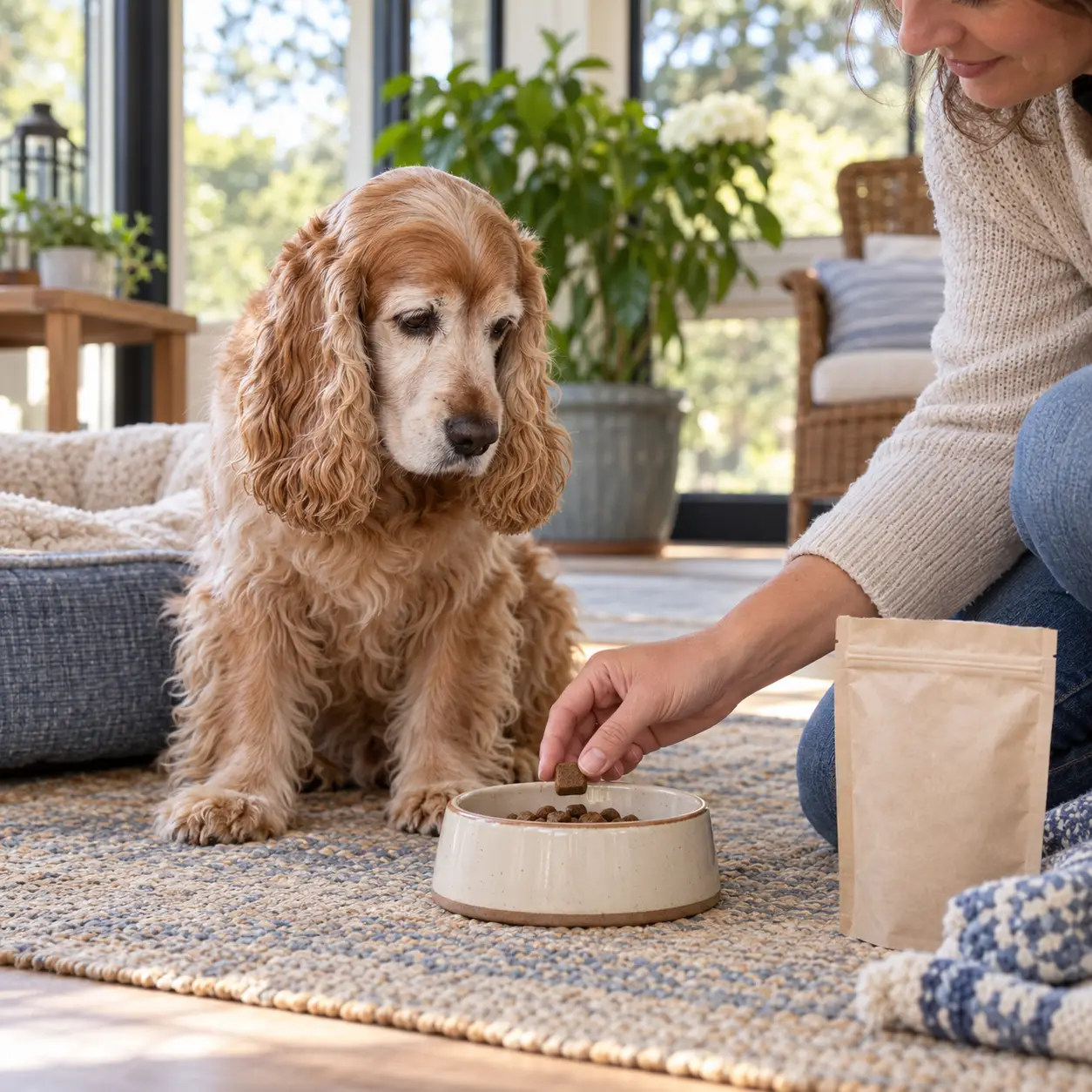
Nutramax Dasuquin MSM Joint Supplement, Small/Medium Dogs, Soft Chews, 84ct
Dasuquin MSM Small/Medium — Check price on Amazon
Dasuquin MSM is the step-up option from the same company as Cosequin. It keeps glucosamine, chondroitin and MSM and adds ASU, boswellia and green tea extract, in a soft chew. The listing we checked is the Small/Medium size for dogs under 60 pounds. If your dog is bigger, choose the large-dog version on the same Amazon page rather than doubling up the small one.
Best for: Dogs under 60 pounds, and owners whose vet suggests a formula with ASU.
Large and giant breeds
Made for big dogs: Wuffes Advanced Hip & Joint Chews for Large Breed Dogs, 30 Pork Chews
Check price on Amazon
Wuffes is a pork-flavored chew. If your dog has a pork or fish allergy, read the full ingredient list before ordering.

Wuffes Advanced Hip & Joint Chews for Large Breed Dogs
Wuffes is formulated specifically for large and giant breeds, with what the maker describes as a higher concentration of active ingredients. It packs the most ingredients of the four into one chew: glucosamine, chondroitin, MSM, green-lipped mussel, hyaluronic acid and omega-3s. The 30-chew pack runs out faster than the others, so check how many chews your dog’s weight calls for per day before you compare costs.
Best for: Labs, shepherds, goldens and other big dogs whose owners want one chew that covers several ingredients.
How to Choose the Right One for Your Dog
- Size first. Dosing is by body weight. Pick a product and size that matches your dog, and do not split or stack products made for other sizes.
- Tablet or soft chew. Chewable tablets are compact; soft chews are easier for dogs who spit out anything that looks like a pill.
- Allergies and flavor. Check the protein source and flavor (chicken, pork, krill or fish oils) against anything your dog reacts to.
- One product at a time. Many joint chews share the same ingredients. Giving two at once makes it hard to judge results and can double some ingredients.
How to Start a Joint Supplement (and Know If It’s Working)
- Follow the label exactly. Some products use a higher starting amount for the first weeks, then a lower ongoing amount.
- Write down three things you can actually see: how your dog gets up after a nap, how long the walk is before they slow down, and whether they hesitate at stairs or the car. Check again after several weeks.
- Watch for an upset stomach, especially in the first days. Stop and call your vet if you see vomiting, diarrhea or anything that worries you.
Track specific, repeatable observations—such as how long your dog walks before slowing down, how easily they rise after a nap and whether they hesitate at stairs or the car. Those notes can help you and your veterinarian judge whether anything has changed.
Home Changes That Help Stiff Dogs Right Now
Supplements work slowly at best. These changes help from day one, and they matter even more in cold weather, when many owners notice their older dog moving stiffly in the morning:
- Cut out the big jumps. A ramp or steps for the car and the couch saves a lot of hard landings. Our dog car ramps and stairs guide compares the options.
- Give them a supportive bed. A thick, supportive bed away from cold floors and drafts makes getting up easier. See our orthopedic dog bed picks.
- Add traction. Runner rugs on slick hallways and stairs help a stiff dog feel steady.
- Keep walks steady. Several shorter, gentle walks are often easier on a stiff dog than one long weekend hike. Ask your vet what level of activity suits your dog.
- Keep weight in check. Extra pounds put extra load on sore joints. Your vet can tell you your dog’s ideal weight.
- Dress for the cold. Short-coated and older dogs may move better on winter walks with a fitted coat. Our dog winter coats and boots guide covers fit.
FAQ
When should I start a joint supplement for my dog?
There is no single right age. Many owners start when they notice stiffness, or when their vet suggests it for a large breed or an older dog. Ask your vet at your dog’s next checkup, especially if you have seen changes on walks or at the stairs.
Can I give my dog my own glucosamine?
Stick with products made for dogs. Human supplements are dosed for people, and some human chewables and gummies are sweetened with xylitol, which is toxic to dogs. If you want to use something from your own cabinet, ask your vet first.
How long until I see a difference?
It varies, and some dogs never show an obvious change. Give one product a fair, consistent trial of several weeks at the label dose, keep your notes, and review them with your vet. If nothing has changed, ask whether to switch or try another approach.
Can my dog take a joint supplement with pain medication?
Many dogs do, but that is a question for your vet, who knows your dog’s medications and health. Bring the actual product or a photo of the label to the appointment.
Final Take
For most stiff or senior dogs, the plan is simple: a vet visit for any new stiffness, one dog-made joint supplement dosed by weight, and a few home changes that take the strain off. Start with Cosequin if you want the familiar choice, VetIQ if budget or picky eating is the issue, Dasuquin MSM for a step-up in a dog under 60 pounds, and Wuffes for a big dog. Add a ramp, a supportive bed and better traction, keep notes, and check in with your vet. That combination gives your dog the best shot at more comfortable days.
Seasonal pet tips and gear guides
Get seasonal pet-care tips and buying guides with fit, care, and maintenance details. Unsubscribe anytime.