
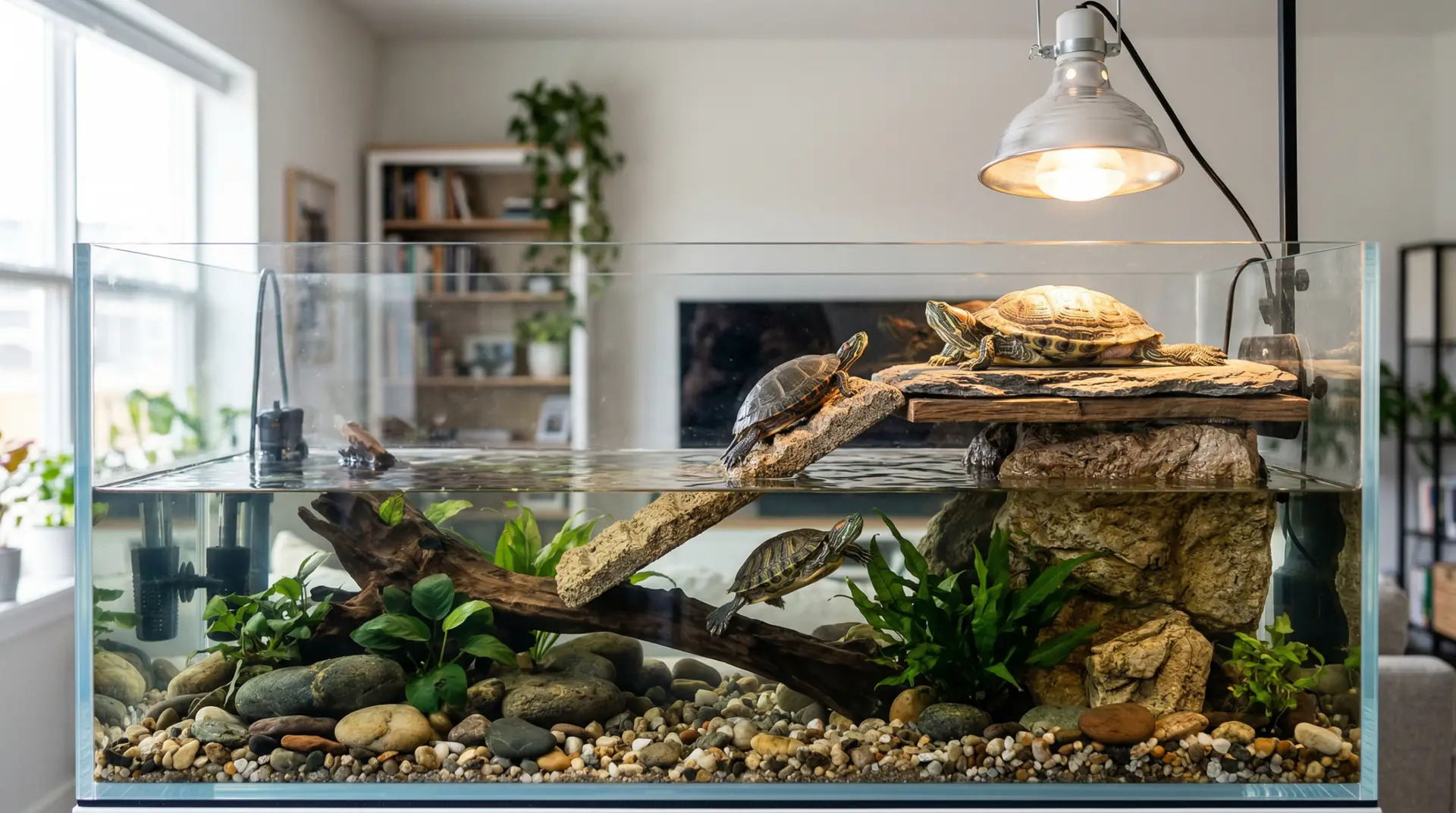
Best Basking Platforms for Aquatic Turtles
Aquatic turtles need access to an appropriate dry basking area with species-appropriate heat and UVB. Check that the platform supports the turtle’s whole body and can be reached without repeated slipping. A platform change alone cannot establish the cause of shell changes or odor; review the enclosure and consult a reptile veterinarian about concerning shell changes. For tank odor, see our tank odor troubleshooting guide.
Six named basking platforms to compare by usable dry area, mounting method, and your turtle's size. If you're still working out the rest of the enclosure, start with our tank setup guide and pair whatever dock you choose with UVB lighting and a water heater.
Quick picks: check dry area against your turtle's full body size
Floating dock: Penn-Plax Reptology Floating Turtle Pier
Check price on Amazon
Suction-cup ramp: Penn-Plax Reptology Turtle Basking Platform Ramp
Check price on Amazon
Hanging platform: SKARUS Extra Large Hanging Turtle Basking Platform
Check price on Amazon
How We Picked These
Compare the usable dry area, mounting method, supported load, cleaning instructions and ramp access. Check the exact model’s dimensions and installation instructions against your turtle and enclosure before ordering.
Floating Dock Option: Penn-Plax Reptology Floating Turtle Pier and Basking Platform (Medium, REP601)
Fit checks: Confirm REP601’s usable dry area and load limits against the turtle’s full body size and your enclosure dimensions.
Confirm REP601's supports, mounting instructions, usable dimensions, and load suitability before purchase. A floating deck must remain fully dry under your turtle's weight.
Installation checks: Follow the exact model’s water-depth and support instructions. Observe the ramp and deck under the turtle’s weight; stop using it if the deck submerges or the supports shift.
Suction-Cup Ramp Option: Penn-Plax Reptology Turtle Basking Platform Ramp (Suction-Cup Style)
Penn-Plax Reptology Turtle Basking Platform Ramp — Check price on Amazon
Fit checks: Verify the deck dimensions, supported load and suction-cup installation; the turtle’s whole body must fit on the dry area.
Verify the suction-cup placement and mounting instructions. Observe whether the turtle can climb onto the deck without repeated slipping.
Installation checks: Compare the current price, deck size and mounting requirements. Check the attachment points regularly and observe stability under the turtle’s weight.
Small Floating Dock Option: Zoo Med Mini Turtle Dock
Zoo Med Mini Turtle Dock — Check price on Amazon
Fit checks: This is a mini-size floating dock suited to hatchlings and small juveniles. Compare its usable dry area and load limits with your turtle and tank; larger turtles need one of the bigger docks on this page.
Installation checks: Follow the platform’s load and water-depth instructions. Check that its usable deck stays dry and stable, and clean it using the manufacturer’s directions.
Dock Option: Large Floating Turtle Dock (DBDPet)
Large Floating Turtle Dock (DBDPet) — Check price on Amazon
Fit checks: Check the listing’s installed dimensions, load limit and dry deck area against your turtle’s size and enclosure.
Confirm the exact dock’s construction and mounting instructions. The usable deck must support the turtle’s whole body above the water; dock choice alone cannot diagnose or treat a shell problem. For enclosure odor checks, see our odor troubleshooting guide.
Installation checks: Measure the space the installed dock occupies. Check that it remains stable and fully dry under the turtle’s weight and can be removed for cleaning as directed.
Ramp Platform Option: MLONDHSU Large Turtle Basking Platform with Non-Slip Ramp
Large Turtle Basking Platform, Non-Slip Ramp (Adjustable Height) — Check price on Amazon
Fit checks: Verify the model’s mounting method, height adjustment, load limit and required enclosure clearance.
Pros: confirm the mounting range, ramp access and removal procedure; observe the installed deck under the turtle’s weight. Flag: newer third-party listing rather than an established name-brand — double-check current specs and reviews before ordering.
Hanging Platform Option: SKARUS Extra Large Hanging Turtle Basking Platform
SKARUS Extra Large Hanging Turtle Basking Platform — Check price on Amazon
Fit checks: SKARUS lists this platform for 65- to 150-gallon tanks at least 21 inches deep. Confirm mounting compatibility, usable deck dimensions, load limits and current price.
Pros: compare current price, dimensions and mounting instructions; a spare platform still needs the same dry-area and load checks. Cons: check the ramp surface, attachment stability and load limit; stop using the platform if it shifts or cannot support the turtle’s whole body. Flag: smaller third-party brand — confirm current listing details before buying.
Buying Criteria
Weight capacity — check species guidance, not just tank-size range. Stability — strong filter current or multiple turtles can tip floating docks; see turtle filtration guide and canister filter roundup. Ease of cleaning — look for a design you can lift out whole and scrub. Ramp angle — observe whether the turtle can climb onto the dry deck without repeated slipping. Review access, stability and species-appropriate heat and UVB; a ramp adjustment alone cannot explain a shell problem. For enclosure odor checks, see our odor post.
FAQ
How big should a turtle's basking platform be?
The usable dry area must support the turtle’s whole body without it hanging over the edge. In a shared enclosure, each turtle needs access to appropriate dry basking space; a single platform’s size does not establish that the overall enclosure is suitable.
Do floating docks work in every tank?
Only when the dock fits the tank and supports the turtle while keeping its entire body dry. Check mounting and load limits; current and movement can destabilize a dock.
How do I know if the ramp angle is too steep?
Watch a few climb attempts. Repeated sliding back means switch to a shallower, textured ramp.
Can I use a DIY platform instead of a store-bought dock?
Yes, but apply the same criteria: enough dry area, secure footing, a climbable ramp angle.