
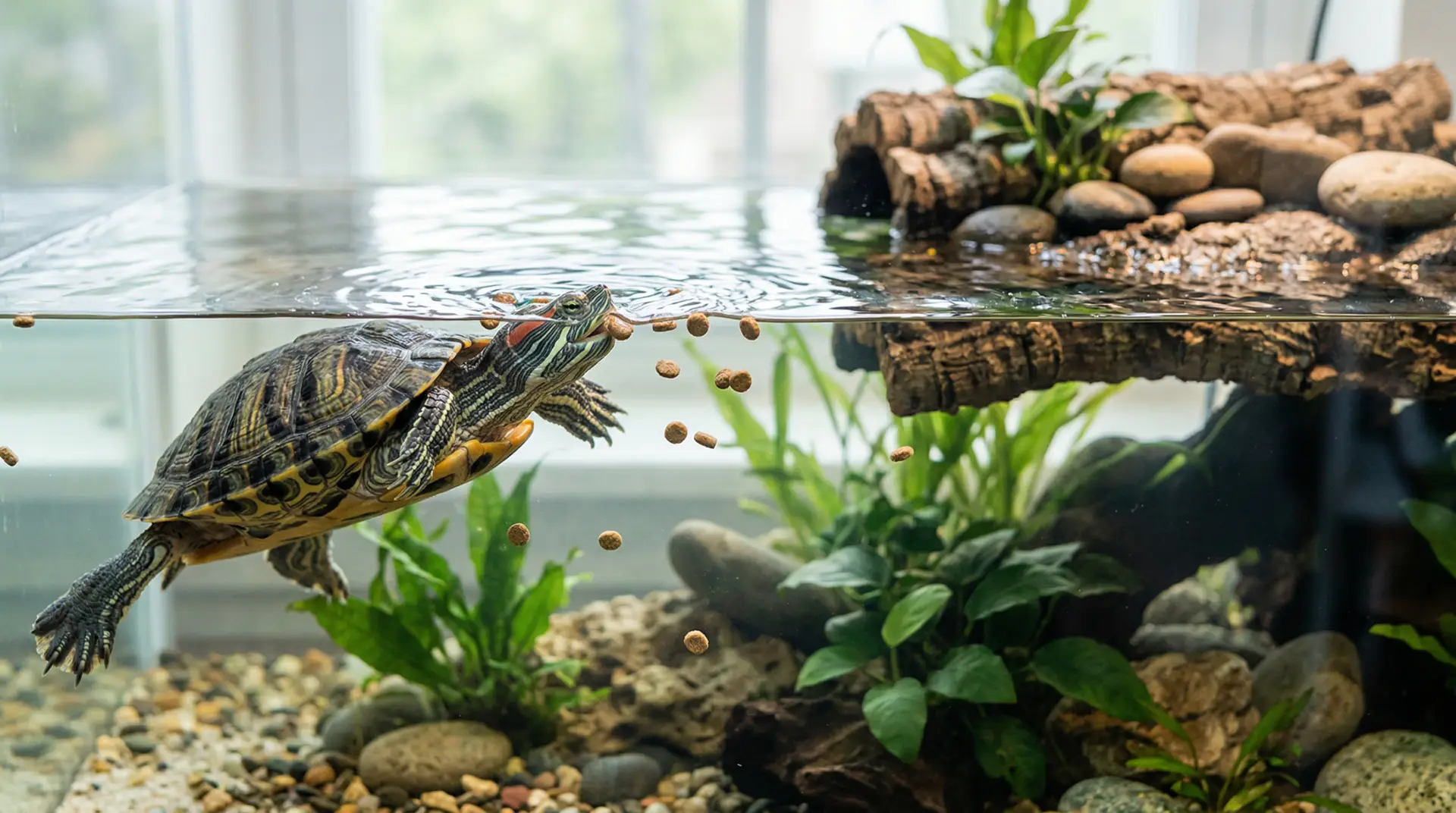
Why Won't My Turtle Eat? Habitat Checks and When to Call a Vet
A turtle that stops eating needs a review of its habitat, feeding and recent changes. Appetite loss can also be a sign of illness; contact a reptile veterinarian about unexplained or persistent refusal rather than assuming a home adjustment will resolve it.
Warning Signs That Need Veterinary Advice
Contact a reptile veterinarian urgently for breathing difficulty, swollen or closed eyes, shell changes, unusual lethargy or abnormal floating. Weight loss and unexplained or persistent appetite loss also need prompt advice; do not use a fixed waiting period.
These warning signs need veterinary assessment. The checks below can help you describe the habitat and recent changes, but the absence of these signs does not rule out illness.
Check 1: Verify Water and Basking Temperatures
Turtles rely on environmental warmth for normal activity and digestion. Check actual water and basking temperatures against care guidance for the species and age; incorrect temperature is one possibility alongside illness, diet and stress.
Temperature targets depend on species, age and care needs. Measure water and the basking surface separately and confirm suitable targets with a reptile veterinarian or a species-specific care source.
Heaters fail, get unplugged, or drift out of calibration without any obvious sign.
The fix: Get an actual reading, not a guess.
AQUANEAT Digital Aquarium Thermometer
If measured water temperature is outside suitable species-specific targets, review the existing heater, settings and installation. Compare a replacement only when needed and compatible with the habitat:
Fluval M-Series Submersible Aquarium Heater
If measurements show inadequate basking warmth, review the heat source and its placement. Verify the exact product’s purpose and instructions; changing a lamp does not diagnose appetite loss:
Zoo Med Repti Basking Spot Lamp
Full water heater buying guide | UVB and basking lighting guide
Recheck appetite after correcting a verified habitat problem, and contact a reptile veterinarian if refusal persists or other symptoms appear.
Check 2: Review Recent Moves and Habitat Changes
Common triggers: recently brought home, moved to a new/resized tank, a new tankmate, rearranged decor, loud noise/foot traffic/location change.
A move or tank change can contribute to stress, but it does not rule out illness. Monitor appetite and other signs and ask a reptile veterinarian if the change persists.
Habitat review: Minimize unnecessary handling and review recent changes. Do not assume waiting or a new platform will resolve unexplained appetite loss.
Penn-Plax Reptology Turtle Pier and Basking Platform
Follow an appropriate feeding plan for the turtle and keep the routine consistent. Avoid unnecessary handling while you review the change with a reptile veterinarian.
Tank setup and layout basics | Basking platform roundup
Check 3: Review Water Care and Filter Condition
Review measured water conditions, filter flow and maintenance. A filter problem or clear-looking water does not establish the cause of appetite loss; share habitat observations with a reptile veterinarian.
Record changes in odor, clarity, filter flow and maintenance. These observations are useful for the habitat review, but appearance and smell alone do not identify the cause.
Filter options to compare if the habitat review identifies a need:
Fluval FX4 High Performance Canister Filter
Another linked model to assess against the actual habitat and waste load:
EHEIM Classic Canister Filter 2213
Filtration sizing and setup guide | Canister filter roundup
Review water quality and maintenance before deciding whether to replace the filter. Clear-looking water or a normal smell does not establish that the habitat is suitable.
Check 4: Discuss Seasonal Changes With a Reptile Veterinarian
A seasonal change is something to discuss with a reptile veterinarian. An apparently stable habitat and the time of year do not establish that appetite loss is harmless.
Observations to share with the veterinarian:
| Observation | What to report |
|---|---|
| Appetite and timing | When refusal began, the usual diet and recent changes |
| Activity and swimming | Basking changes, lethargy or abnormal floating |
| Eyes, breathing and shell | Swelling, discharge, breathing difficulty or new shell changes |
| Habitat measurements | Actual temperatures, water care and filter maintenance |
| Body condition | Weight changes and any other symptoms |
Habitat and Symptom Checklist
- Test water and basking temps directly with a thermometer
- Record recent changes to the tank, tankmates or environment
- Review water care, measured conditions, filter flow and maintenance; clarity or smell alone is insufficient
- Consider the season
- Contact a reptile veterinarian about unexplained or persistent refusal, and urgently for concerning symptoms
FAQ
How long can a turtle safely go without eating?
There is no universal safe waiting period. Age, species, body condition, temperature, and symptoms matter; contact a reptile veterinarian for an appropriate plan.
Is it normal for a turtle to stop eating in winter?
Do not assume winter makes appetite loss normal. Habitat temperature can affect activity, but seasonal timing and normal-looking basking do not rule out illness; ask a reptile veterinarian about the change.
What temperature should turtle tank water be for a good appetite?
Suitable water and basking temperatures depend on species, age and care needs. Measure each area and confirm appropriate targets with a reptile veterinarian or a species-specific care source.
Can bad water quality really cause a turtle to stop eating?
Water care is one part of the habitat review. Check measured conditions and maintenance; unexplained or persistent appetite loss still needs reptile-veterinary advice.
When should I take my turtle to the vet for not eating?
Contact a reptile veterinarian promptly for unexplained or persistent appetite loss, and urgently with breathing trouble, swollen eyes, shell changes, lethargy, or abnormal floating.