
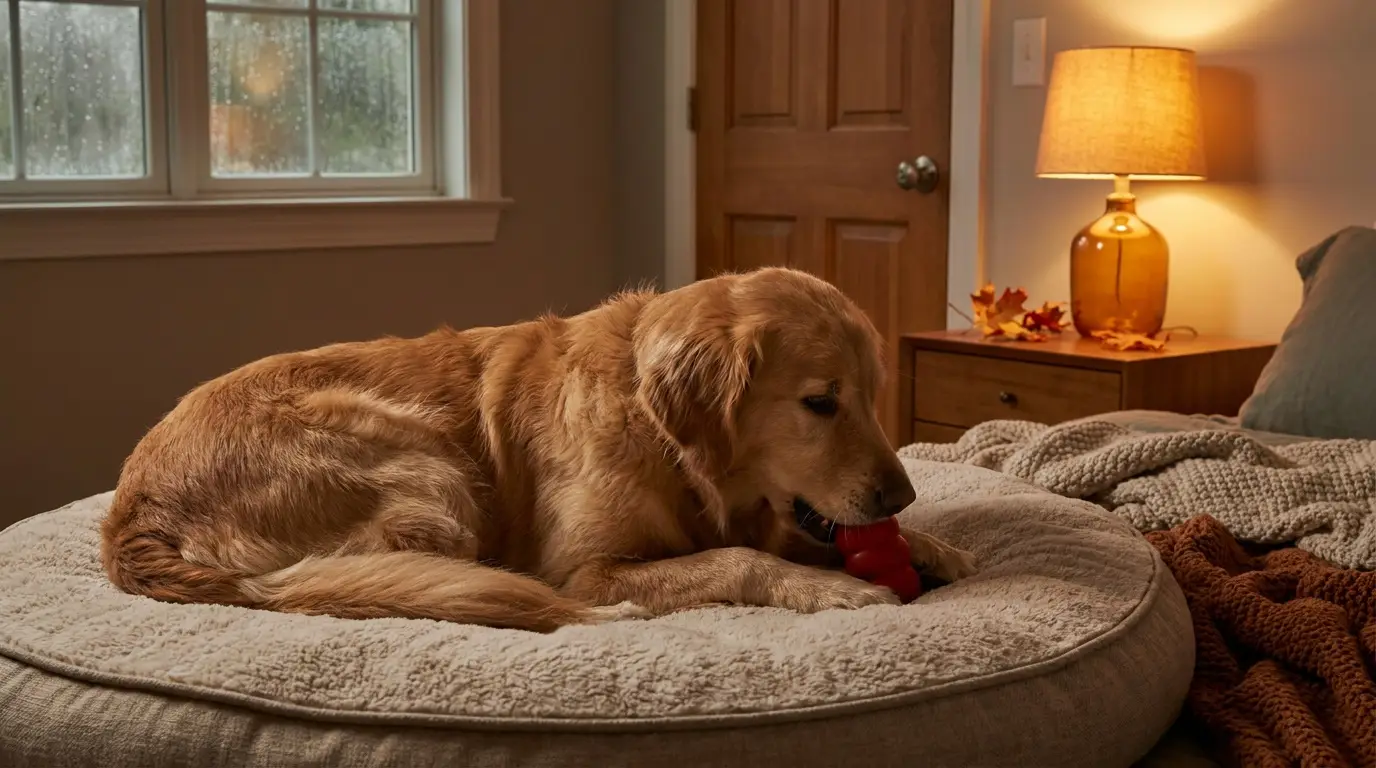
Forty doorbell rings, strangers in masks, a floor full of candy, and a door that never stays shut. Here’s the room-by-room plan that gets every dog through Halloween night calm and safe.
Affiliate Disclosure: As an Amazon Associate, PawsFinsandShells earns from qualifying purchases. Some links below are affiliate links — we may earn a small commission at no additional cost to you.
Halloween night is a stress test built specifically for dogs: territorial triggers (doorbell, knocking, strangers on the porch) on repeat for three hours, plus costumed silhouettes that read as wrong to a dog’s threat detection, plus chocolate at nose height. Shelters and pet-recovery services consistently report a spike in lost-pet cases around October 31 — a door that opens forty times is forty escape chances. The fix isn’t training your dog out of it in the next few weeks; it’s managing the night so the triggers never reach them. This is the same playbook as our July 4th fireworks guide, adapted for the door.
Step 1 — Build the Quiet Room (Before Dark)
Pick the room farthest from the front door — a back bedroom beats the kitchen every time. Set it up an hour before the first trick-or-treaters: water bowl, their regular bed (this is a great night for the good bed — the orthopedic picks if your dog’s earned an upgrade), a piece of your recently-worn clothing, lights on low, door closed. The dog goes in before the first doorbell, not after the fifth. If your dog crate-rests happily, the crate goes in the quiet room too with the door open — familiar den, new location.
Step 2 — Mask the Doorbell
The doorbell is the trigger; make it disappear. A white noise machine near the quiet-room door (not next to the dog) flattens the bell and the porch chatter into background. Turn it on before the noise starts so it’s ambience, not a new event.
LectroFan Classic Sound Machine
Twenty fan and white-noise settings, no looping tracks, loud enough to cover a doorbell without being loud in the room.
Low-tech additions that help: disconnect the doorbell for the night and sit outside with the candy bowl, or tape a “please knock softly” note over the button. Nobody trick-or-treating has ever minded.
Step 3 — The Two-Hour Distraction
A bored dog in a quiet room hears everything. A dog working on a frozen stuffed KONG hears nothing. Stuff it with kibble and a smear of peanut butter (xylitol-free — check the label) and freeze it that afternoon; frozen, it lasts most of the trick-or-treat window.
KONG Extreme
The black-rubber version built for serious chewers. Two on rotation — one in the freezer, one in use — is the pro move. More heavy-duty options in the aggressive chewer guide and the full dog toy guide.
Step 4 — The Pressure Wrap (For Dogs Who Need More)
If your dog trembles or paces through fireworks and thunderstorms, Halloween will read the same way, and the quiet room alone may not be enough. A snug pressure wrap takes the edge off for many dogs — it’s a comfort aid, not a cure, and it works best introduced a few days early so it isn’t one more strange thing on the strange night. Dogs who shake or pant at night during ordinary weeks deserve a vet conversation beyond any product; severe panic — self-injury, destroying doors — is a veterinary behaviorist issue, not a gear issue.
ThunderShirt Calming Anxiety Vest
The standard gentle-pressure wrap, sized by chest girth. Fit it snug — loose defeats the point.
Step 5 — Lock Down the Candy
Chocolate and xylitol are the night’s real monsters
Chocolate toxicity scales with darkness — baking chocolate is the worst — and xylitol (in many sugar-free gums and candies) is dangerous in tiny amounts. The candy bowl lives on a high shelf or behind a cabinet door between rings; dropped candy gets picked up immediately; kids’ hauls get sorted on a table, not the floor. If your dog gets into candy anyway: call your vet or an animal poison control line right away, wrapper in hand. Numbers and a full kit belong in your emergency preparedness setup — build it before the season, not during the incident.
Step 6 — If Your Dog Joins the Walk
Some dogs love the neighborhood parade — if yours already enjoys busy evening walks, here’s the checklist: harness with the leash on the harness, never on a costume (the no-pull harness guide if pulling is the issue); ID tag current and microchip info verified that week; reflective or lit gear once the sun’s down; and home the first time the dog looks overwhelmed — ears back, tail low, refusing treats. Skip houses with strobe effects or animatronics.
BSEEN USB-Rechargeable LED Collar
Bright, rechargeable, and visible from both directions of the street — the single best safety upgrade for an after-dark walk, on Halloween or any night.
And if the costume itself is the open question — what fits, what your dog will actually tolerate, what to use instead — that’s the whole first half of our Pet Halloween HQ, including the bandana-and-glow-collar route that most dogs prefer anyway.
The Night-Of Checklist
- Afternoon: long walk or hard play session — a tired dog sleeps through more.
- KONG stuffed and in the freezer by 3pm.
- Quiet room set by 5pm: water, bed, worn shirt, white noise on, lights low.
- ID tag on, microchip info current, gates and fence latches checked.
- Candy bowl staged out of reach; floor policy announced to the kids.
- Dog in the quiet room before the first bell; check-ins between waves, calm and brief.
- Wrap and lit collar on walkers; leash on harness, never costume.
Last updated: September 19, 2026. Availability checked September 19, 2026.
Get the picks before the season rush
A few emails a year - Halloween, the holidays, and the big deal days - with every pick already checked in stock. No spam, unsubscribe anytime.