
CAT BEHAVIOR
Why Does My Cat Knock Things Off Tables?
Knocking an object from a table can involve play, investigation or a learned response. Watch the context and keep fragile or hazardous items out of reach before trying to redirect the behavior.
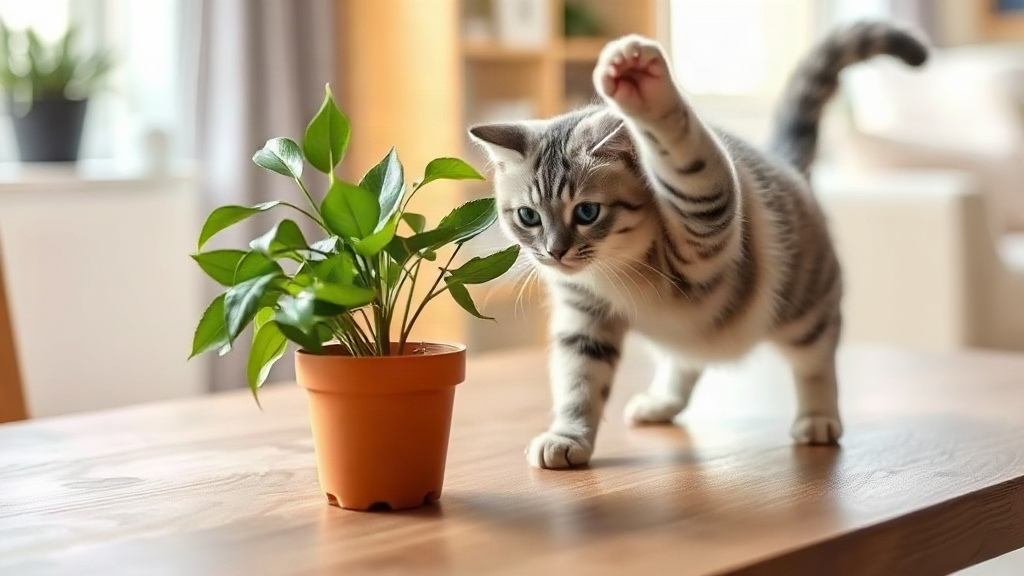
Watch when object-batting happens; one paw movement does not tell you the cause.
Object-batting can be frustrating. Observe the setting and your cat’s other behavior, remove hazards and offer appropriate play opportunities without assuming a single explanation.
Why Cats Do This
Predatory Testing Instinct
Cats may bat and chase moving objects during play. Offer suitable toys rather than loose household items that could break, be swallowed or cause injury.
A wand toy is one option for supervised play. Choose a toy your cat can use safely, put strings away afterward and observe what interests them; it does not guarantee that table-batting stops. Check Price on Amazon
Attention-Seeking
Your reaction may become part of a repeated pattern. Notice what happens before and after object-batting rather than assuming your cat is deliberately demanding a particular response.
Offer predictable opportunities for play and interaction when your cat is receptive. Reward suitable activities; the response to changes varies.
Boredom and Lack of Stimulation
Review opportunities to play, climb and explore, but do not diagnose boredom from table-batting alone or assume that living with another cat prevents it.
Rotate appropriate toys and review accessible perching space. Before choosing the linked tree, check its dimensions, stability and your cat’s access needs. Check Price on Amazon
Learned Reward Behavior
Repeated actions may be maintained by their consequences. Keep your response consistent and reward alternatives, without a fixed prediction about how many repetitions change the behavior.
Observe whether particular reactions or activities follow table-batting, and plan suitable alternatives before the pattern starts. There is no guaranteed training timeline.
Curiosity and Sensory Exploration
Cats investigate objects with their paws and senses. Keep medication, small swallowable items and breakables securely out of reach rather than offering them as play objects.
Notice whether new objects attract your cat, and store them safely when you cannot supervise. Individual interests vary.
Practical Steps
- Remove hazards. Store small swallowable items, medication and breakables securely out of reach.
- Offer supervised play. Try short sessions suited to your cat’s interest and mobility, and put string toys away afterward.
- Consider food puzzles. Choose an appropriate difficulty, account for the food used and check that your cat can eat comfortably.
- Review perching space. Secure suitable trees or shelves according to their instructions and provide access your cat can manage.
- Manage access. Move vulnerable objects or use a suitable physical barrier. Do not apply an unverified citrus spray or assume an adhesive surface is suitable for every cat.
- Offer alternatives. Encourage a suitable toy or perch without forcing handling or startling your cat.
- Reward the behavior you want. A treat or praise when your cat chooses the cat tree or a toy over the counter reinforces the pattern you’re actually trying to build.
Frequently Asked Questions
Is my cat doing this on purpose?
A controlled paw movement does not tell you its motivation. Consider play, investigation and learned responses without attributing revenge.
Should I ever say “no” to my cat?
Use consistent, reward-based alternatives rather than relying on a verbal reprimand or exact timing. Avoid frightening or physical punishment.
Does this behavior mean my cat is stressed?
Table-batting alone does not diagnose or exclude stress or illness. Discuss a sudden change or accompanying hiding, appetite change or excessive grooming with your veterinarian.
Will getting a second cat fix it?
Do not add another cat as a presumed cure. Compatibility, introductions and separate resources need consideration; another animal may add stress.
More Cat Guides
Final Take
Keep hazardous items out of reach, watch the context and offer suitable play and perching opportunities. Reward alternatives and reassess if behavior changes or other signs appear; enrichment does not guarantee that counter activity ends.